The Hanko Holding Your Container: Why Japanese Export Paperwork Still Sets Your US Delivery Date
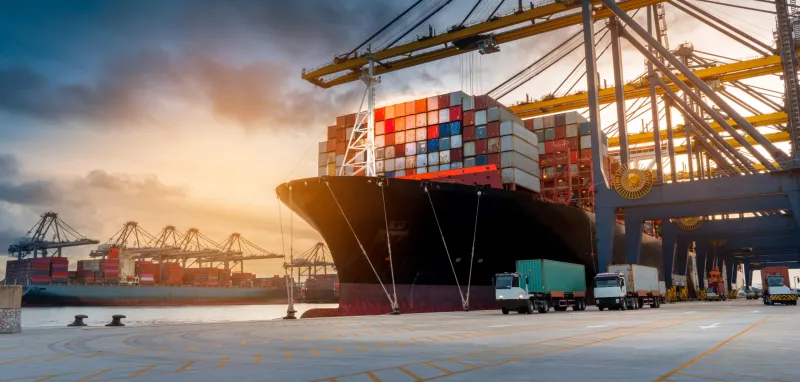
Photo: shipping documents and rubber stamp on desk at export office, via www.hazmatuniversity.com
Your container is booked, the cargo is staged at a Tokyo container yard, and the vessel cutoff is still days away. Your distribution center in Ohio has already pushed the receiving appointment back a week. Nothing physical failed. What failed was a courier packet.
Japanese export trade remains one of the most document-intensive commercial corridors in the world. Digitization has arrived at the edges — booking platforms, track and trace, electronic customs declaration through NACCS — but the contractual spine of the transaction still runs on signed originals, registered company seals, and overnight envelopes. For a US importer, that spine is not an administrative curiosity. It is a lead-time variable, and it usually sits entirely outside the transit-time model.
Following the packet, handoff by handoff
Supplier to forwarder. The booking instruction is where small errors become expensive. Consignee, notify party, marks, and description must match the commercial invoice, the letter of credit where one exists, and the importer of record exactly. In many Japanese companies the shipping instruction is still sealed with the company hanko, and where the transaction runs through a bank, a seal registration certificate may be requested as well. A document that needs a director's seal on a Friday afternoon, with that director traveling, is a three-day delay before the cargo has moved a meter.
Export declaration. The forwarder or the supplier's customs broker files the export declaration. Invoice, packing list, and any license or permit — METI-controlled goods, dual-use items, certain food and agricultural products — must be complete and internally consistent. Japan's export controls have tightened considerably in recent years, and a classification that once passed unremarked can now trigger a review that stops the shipment at the declaration stage rather than at the port.
Bill of lading issuance. Originals are typically issued in a set of three, signed by the carrier or its agent, against the mate's receipt. The set is negotiable. Whoever holds a properly endorsed original controls the cargo, which is exactly why the banking system still relies on it and exactly why it is so hard to retire.
The courier leg. Originals still travel by international express, typically two to five business days from Japan to the US, longer if the packet leaves on a Friday or lands during Golden Week, Obon, or the New Year shutdown. If a letter of credit requires a full set presented to a nominated bank, add bank transit on both ends. Ten days of pure paperwork float is normal. Fifteen is not rare.
ISF and entry. Meanwhile the Importer Security Filing must be transmitted at least 24 hours before loading at the foreign port. That data comes from your supplier, not from the carrier, and a late or amended filing exposes you to liquidated damages. Later, your customs broker files entry in ACE, needing the commercial invoice, packing list, arrival notice, and any partner government agency data.
The assumption that costs the most
Many US importers believe US Customs and Border Protection demands an original bill of lading before releasing cargo. It does not. Entry is filed electronically, and CBP's document requirements are satisfied through ACE submission and post-entry production on request. The original bill of lading is demanded by two other parties: the ocean carrier, whose contract of carriage says so, and the bank, whose letter of credit says so.
That distinction matters because it tells you where to negotiate. You cannot argue with a regulation. You can absolutely rewrite a purchase order.
When to push for telex release — and when not to
Telex release works like this: the shipper surrenders all originals at the origin office, and the carrier instructs the destination agent to release cargo to the consignee against identity and a guarantee. It is faster by design, but it is only available while the originals are still in the shipper's hands. Once they sit in a courier envelope bound for a bank, telex release is off the table without that bank's cooperation.
Push for telex release, a sea waybill, or an electronic bill of lading platform when there is no letter of credit; when the consignee is a known affiliate or long-standing buyer; when the cargo is not high-value or easily diverted; and when your carrier supports the mode commercially.
Do not push for it when a letter of credit stipulates a full set of originals; when the transaction runs against documents with a Japanese trading company as intermediary; or when your own treasury controls require negotiable documents as payment security.
A practical checklist
- Decide document modality at the purchase order stage, not at booking. The PO is the only place where the choice is free.
- Ask the supplier, in writing, who holds seal authority for the shipping instruction, and what happens during holiday closures.
- Require scanned copies of invoice, packing list, and draft bill of lading within 24 hours of vessel departure, sent directly to your broker and copied to you.
- Separate the ISF data request from the document packet request. They run on different clocks and are often owned by different people inside the supplier.
- Pre-arrange a courier account with a defined daily cutoff, and specify the delivery address as your customs broker rather than your own office.
- On repeat lanes, negotiate a sea waybill with the carrier and amend PO terms to match before the next cycle begins.
- Build a five-day paperwork buffer into every promise date you give your own customers. If the buffer is never used, you have data. If it is always used, you have a supplier conversation to have.
Paper weighs nothing and never appears on a load plan. On Japan-origin freight, though, it is the last mile of the lead time — and the mile most US importers never chart.